
Almanac today: 29 Nov 2026 · UTC+8 time zone
 小
Minor Cold
節The twenty-third of the twenty-four solar terms, marking the start of the coldest period of the year.
- Jie start in 2026
- Jan 516:23
- Solar ecliptic longitude
- 285°
- Order of solar terms
- Winter · No. 23
Next Minor Cold: Jan 5, 2027 22:10, in 37 days (UTC+8 time zone)
What Is Minor Cold?Introduction
Minor Cold is winter's fifth solar term. Like Major Cold, Minor Heat and Major Heat, it reflects changes in temperature and also falls around the turn of the year.
The Collected Explanations of the Seventy-Two Pentads of the Monthly Ordinances (月令七十二候集解) explains that the cold is still minor at the beginning of the month and becomes greater by its middle: the cold has not yet reached its greatest intensity, hence ‘Minor Cold’.
Astronomy and Calendar
Minor Cold falls around Jan 5 or 6 in the Gregorian calendar and is the twenty-third of the twenty-four solar terms.
The Sun reaches ecliptic longitude 285°, after Winter Solstice and before Major Cold. Minor Cold's arrival marks the start of the year's coldest period.
Minor Cold: Jie Start Times
| Year | Jie start time (UTC+8 time zone) | |
|---|---|---|
| 2025 | Jan 5 Sun 10:33 | Past |
| 2026 | Jan 5 Mon 16:23 | Past |
| 2027 | Jan 5 Tue 22:10 | Upcoming |
| 2028 | Jan 6 Thu 03:55 | |
| 2029 | Jan 5 Fri 09:42 |
Solar ecliptic longitude: 285°. Each year's time is calculated astronomically to the nearest minute.
Season and Climate
Temperatures are very low around Minor Cold, with frequent cold waves, strong winds and snowfall in different regions. South of the Yangtze, people say ‘Minor Cold and Major Cold freeze everything into a block of ice’; in Guangxi, ‘If Minor Cold is not cold, Major Cold will be’.
Dense fog and strong winds are also common in winter, affecting fishing and aquaculture at sea and on rivers and lakes.
Three Traditional PentadsThe Seventy-Two Pentads
- First pentad·雁北乡(Wild geese turn north)
Wild geese sense stirring yang qi and begin migrating north.
- Second pentad·鹊始巢(Magpies begin nesting)
Magpies begin to build nests.
- Third pentad·雉始雊(Pheasants begin to call)
Pheasants call as they sense growing yang qi.
These three pentads come from the Collected Explanations of the Seventy-Two Pentads of the Monthly Ordinances.
Traditional Farming
Minor Cold's very low temperatures can damage wheat, fruit trees, melons and vegetables, livestock and poultry. In the south, wheat and rapeseed need additional winter fertilizer. In Hainan and most of South China, the main tasks are protecting against cold and freezing, gathering and making manure, and building waterworks. After heavy snow, snow should be shaken from fruit-tree branches promptly to keep them from breaking under its weight. Livestock housing needs attention to both temperature and ventilation.
Many farming sayings concern this period, including:
Minor Cold and Major Cold come in January; farmers, keep gathering manure.
Feed cattle well in the coldest winter days and horses in the hottest summer days.
A warm Minor Cold means snow at Beginning of Spring.
If Minor Cold is not cold, Clear and Bright will be muddy.
Thorough cold at Minor Cold and Major Cold brings a warm spring next year.
Seasonal Customs and Foods
Customs
- Preparing New Year suppliesWriting spring couplets and cutting window decorations
- The New Year atmosphere grows stronger at Minor Cold. People begin writing spring couplets, cutting paper window decorations and visiting markets to buy New Year pictures, colored lanterns and incense in preparation for Chinese New Year.
- Seeking plum blossoms
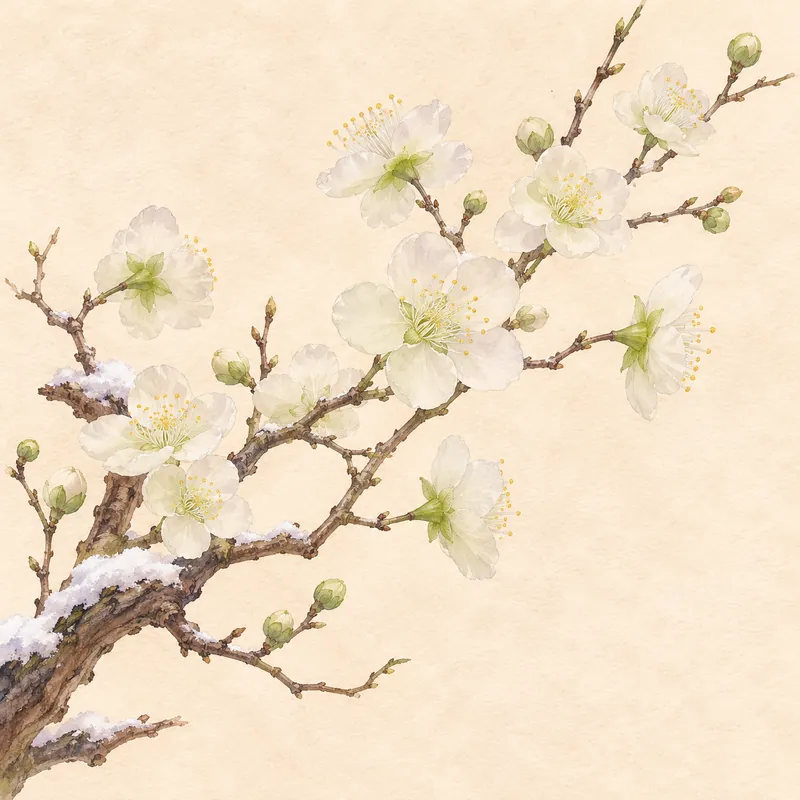
- Wintersweet is already blooming at Minor Cold, while red plum blossoms are still in bud. Finding a place with plum trees in bloom and quietly appreciating them is a traditional winter pastime.
- Ice games
- Northern China freezes in winter, with an ice season that can last from November to the following April. Sledges are used for travel over ice, pulled by horses or dogs or propelled with poles. Ice sleds are set up where the ice is thick, and some people race on skates. Such activities were traditionally called bingxi, ‘ice games’.
Food
- Yellow cabbage shootsTianjin
- Miscellaneous Records of Tianjin (津门杂记) records an old Tianjin custom of eating yellow cabbage shoots at Minor Cold. After Winter Solstice, the cabbage stems and leaves are cut away, leaving only the hearts, which are covered with manure and harvested half a month later.
- Rice with vegetablesNanjing
- People in old Nanjing often cooked rice with vegetables around Minor Cold. Local short-stemmed yellow bok choy, sliced salted pork, sausage or diced salted duck are cooked with ginger and glutinous rice. The ingredients are Nanjing specialties, producing a fragrant, savory dish.
- Glutinous riceGuangzhou
- Guangzhou has a custom of eating glutinous rice for breakfast on Minor Cold, part of Guangdong's folk tradition of eating it at both Minor Cold and Major Cold. Chopped, stir-fried cured pork, Chinese sausage and peanuts are mixed into the rice, with a little chopped scallion white. Glutinous rice and fragrant rice are used in a ratio of roughly six to four. Glutinous rice is traditionally believed to nourish the stomach; its high sugar content is said to warm the body after eating, helping dispel dampness and cold.
Life Today
At Minor Cold today, some northerners still eat mutton hotpot, sugar-roasted chestnuts and roasted sweet potatoes. People in Nanjing, Guangzhou and elsewhere also maintain their customs of vegetable rice and glutinous rice.
Park ice rinks and snow resorts become busy at this time. Ice spinning tops and ice sleds can be seen as continuations of ancient ice games, while spring-couplet writing and paper window cutting signal that Chinese New Year is approaching.
According to traditional health practices, Minor Cold food customs favor warming foods. From this perspective, eating more warm or hot-natured foods can nourish the body; northern winter dishes such as mutton, mutton hotpot, sugar-roasted chestnuts and roasted sweet potatoes follow the saying ‘Nourish yourself through the coldest winter days, and avoid illness next year’. During the cold nine-day periods, appropriate exercise may help healthy people adapt to cold, but it should suit individual circumstances and ability rather than pursue strength indiscriminately. Ice and snow sports should take place at venues with safety provisions. Traditional Chinese medicine holds that ‘blood congeals when exposed to cold’: warmth allows it to flow more readily, while cold encourages stagnation. At this time, cardiovascular and cerebrovascular disease and high blood pressure are therefore said to worsen, and strokes may become more frequent. Keeping warm during daily life and exercise is especially important, particularly for older people. Respiratory diseases also need attention when cold waves arrive. These are traditional folk and Chinese medicine beliefs, provided for cultural understanding only, and do not constitute medical advice.
Solar Terms of Winter
Source: China Intangible Cultural Heritage website Author: China Intangible Cultural Heritage Protection Center