
Almanac today: 29 Nov 2026 · UTC+8 time zone
 寒
Cold Dew
節The seventeenth of the twenty-four solar terms, when cold dew is about to turn to frost.
- Jie start in 2026
- Oct 814:29
- Solar ecliptic longitude
- 195°
- Order of solar terms
- Autumn · No. 17
Next Cold Dew: Oct 8, 2027 20:17, in 313 days (UTC+8 time zone)
What Is Cold Dew?Introduction
Cold Dew is autumn's fifth solar term. The Collected Explanations of the Seventy-Two Pentads of the Monthly Ordinances (月令七十二候集解) describes it as the solar term of the ninth lunar month, when dew is cold and about to freeze.
It is colder than White Dew, and dew on the ground is close to becoming frost, marking the shift from cool to cold weather. A saying goes: ‘Cold Dew, cold dew—cold droplets everywhere’.
Astronomy and Calendar
Cold Dew falls on Oct 8 or 9 in the Gregorian calendar, when the Sun reaches ecliptic longitude 195°. It is the seventeenth of the twenty-four solar terms.
It follows Autumn Equinox and precedes Frost's Descent, corresponding to the ninth lunar month. The Double Ninth Festival also often falls during this period.
Cold Dew: Jie Start Times
| Year | Jie start time (UTC+8 time zone) | |
|---|---|---|
| 2025 | Oct 8 Wed 08:41 | Past |
| 2026 | Oct 8 Thu 14:29 | Past |
| 2027 | Oct 8 Fri 20:17 | Upcoming |
| 2028 | Oct 8 Sun 02:09 | |
| 2029 | Oct 8 Mon 07:58 |
Solar ecliptic longitude: 195°. Each year's time is calculated astronomically to the nearest minute.
Season and Climate
By Cold Dew, most of China has entered autumn. Temperatures continue to fall in the south, while snow generally begins in the northeast and northern Xinjiang. Hainan and Southwest China often have persistent autumn rain; in some years, overcast rain also affects the Yangtze–Huai and Jiangnan regions.
Overall, warm days, cool nights and clear skies predominate, helping the autumn harvest. The rainy season ends after Cold Dew, and the north is often dry with little rain. This is a period of relatively severe snow damage on the plateaus.
Three Traditional PentadsThe Seventy-Two Pentads
- First pentad·鸿雁来宾(Wild geese arrive as guests)
Large flocks of wild geese migrate south in formation.
- Second pentad·雀入大水为蛤(Sparrows enter the sea and become clams)
Seeing fewer sparrows and more clams by the sea, ancient people believed the birds had turned into clams.
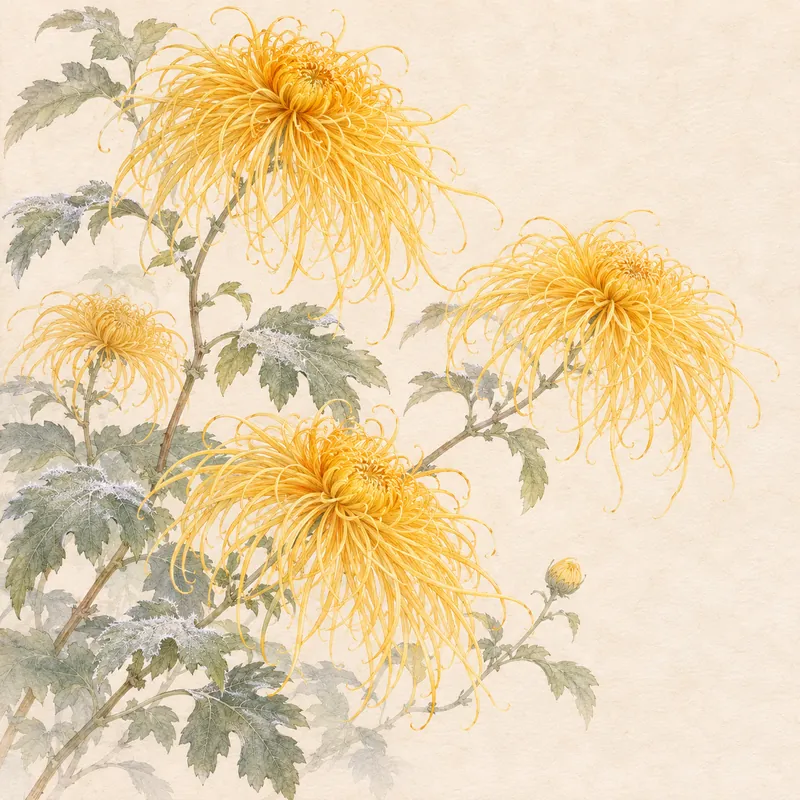
- Third pentad·菊有黄华(Chrysanthemums bear yellow flowers)
Chrysanthemums bloom widely.
These three pentads come from the Collected Explanations of the Seventy-Two Pentads of the Monthly Ordinances.
Traditional Farming
Autumn crops ripen in succession at Cold Dew, and cotton harvesting reaches its busiest stage. Rapeseed and broad bean sowing begins north of the Huai River, while winter wheat must be sown promptly in the north. Dry weather and scant rain after Cold Dew often make timely wheat sowing difficult.
The season's farming sayings are quite specific:
At Cold Dew, everyone is busy sowing wheat, picking cotton and threshing beans.
Autumn Equinox is early and Frost's Descent late; Cold Dew is just right for sowing wheat.
At Cold Dew, cut late rice; at Frost's Descent, cut glutinous rice.
Cotton fears prolonged rain in the eighth lunar month; rice fears a single morning's frost at Cold Dew.
Seasonal Customs
- Climbing heights and viewing chrysanthemums
- Cold Dew falls close to the Double Ninth Festival, on the ninth day of the ninth lunar month. People keep the custom of climbing to high places, looking into the distance over mountainsides in autumn color. The ninth lunar month is also called chrysanthemum month; these are the season's most representative flowers, and climbing and viewing them is a favorite activity.
- Cricket fighting
- The period around White Dew, Autumn Equinox and Cold Dew is the peak season for cricket fighting in places such as Beijing and Hangzhou. Crickets are also called cuzhi, ‘urging weaving’: their call signals autumn and the need to prepare winter clothing. As a saying goes, ‘The cricket calls, and the idle woman starts’.
- Fishing near the shore in autumn
- By Cold Dew in the south, summer heat has receded and sunshine is mild, making it a suitable time to fish outdoors. With falling temperatures, sunlight cannot warm deep water thoroughly, so fish move into warmer shallows. Hence the saying: ‘Fish near the shore in autumn’.
- Drinking chrysanthemum wine
- Cold Dew is close to the Double Ninth Festival, when chrysanthemums are in full bloom. In some regions, chrysanthemum wine is drunk to counter autumn dryness. Brewed with chrysanthemums, glutinous rice and a fermentation starter, it is also called ‘longevity wine’. Its taste is cool and sweet, and it is traditionally believed to nourish the liver and brighten the eyes, while expressing wishes to avert misfortune and receive blessings.
- Drinking Cold Dew tea
- Old Nanjing has a custom of drinking Cold Dew tea. Tea picked in the three days before and four days after Cold Dew is called ‘true autumn tea’, considered the finest autumn tea, with a pronounced, lasting fragrance.
Life Today
People still climb heights and view chrysanthemums for the Double Ninth Festival around Cold Dew. Some also go fishing in the countryside or drink newly available autumn tea.
Old customs such as cricket fighting and drinking chrysanthemum wine sometimes survive as folk events and intangible cultural heritage practices; more often, they become topics people associate with autumn.
According to traditional health practices, a Cold Dew diet should balance the five flavors, with more sweet, mild and moistening foods according to individual needs. These are intended to replenish the spleen and stomach while nourishing the lungs and moistening the intestines, helping prevent and treat a dry throat and mouth. Sesame, glutinous rice, honey and dairy products are favored for their moistening qualities, with moderate additions of meat, fish, shrimp, jujubes and Chinese yam to strengthen the constitution. Eat fewer spicy foods and more seasonal fruits such as pears, grapes, apples and peaches. Sayings such as ‘When the west wind blows, crab legs itch’ and ‘Round aprons in the ninth month, pointed ones in the tenth’ describe this season of yellow chrysanthemums and plump crabs as a good time to eat female crabs. Daily habits follow the saying ‘Do not bare the body at White Dew or the feet at Cold Dew’: add clothing gradually as warmth and cold alternate and mornings and evenings cool. ‘Keep wrapped up in spring and brave some cold in autumn’ means that healthy people may improve cold tolerance through moderate autumn coolness, but suitability varies by person. These are traditional folk and Chinese medicine beliefs, provided for cultural understanding only, and do not constitute medical advice.
The Six Solar Terms of Autumn
Source: China Intangible Cultural Heritage website Author: China Intangible Cultural Heritage Protection Center